
If you’ve been charged with a DWI (also called a DUI) in New Jersey, it depends on several factors — including whether it’s a first offense, your blood alcohol content (BAC), and whether you refused a breath test. We understand that after a DWI arrest, most people aren’t worried about the legal theory — they’re worried about whether they’ll be able to drive to work and take care of loved ones. The good news is that thanks to New Jersey’s 2019 DWI reform, most first-time offenders no longer lose their license at all. Instead, they’re required to install an ignition interlock device (IID) and can keep driving. For a second or third DUI offense, or in cases involving a breath test refusal or a high BAC, actual license suspensions still apply and can range from one year to eight years.
Before December 2019, every DWI conviction in New Jersey came with a mandatory license suspension — even for a first offense. That meant losing the ability to drive to work, pick up your children, or handle daily responsibilities for months or even years.
The 2019 reform (P.L. 2019, c.248) changed the approach for most first-time DWI offenders. Instead of automatically suspending your license, the law now focuses on requiring an ignition interlock device (IID). An IID is a small breathalyzer installed in your vehicle — you must blow into it and register a clean reading before the engine will start. The idea is that you can continue driving and maintaining your daily life, while the state ensures you aren’t driving impaired. This was a major shift, and it’s important to understand because many online resources still describe the old suspension rules.
Not all first-offense DWIs carry the same consequences. Under N.J.S.A. 39:4-50, the license penalty depends on your BAC level at the time of the offense:
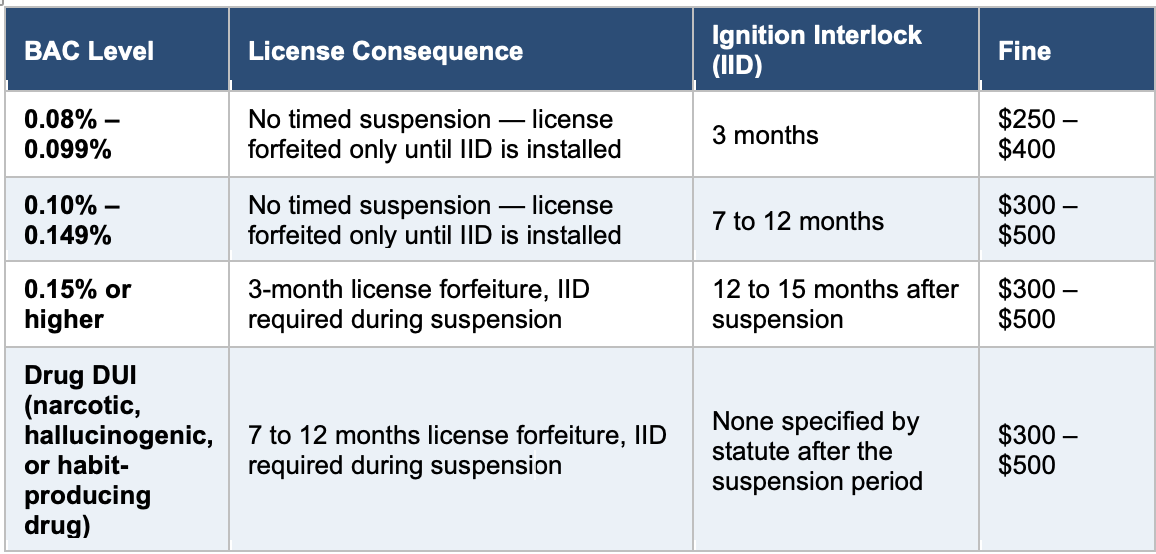
All first-offense DWI convictions also carry a maximum of 30 days in jail (though jail time for a first offense is uncommon), mandatory attendance at an Intoxicated Driver Resource Center (IDRC) for 12 to 48 hours, and an annual insurance surcharge of $1,000 per year for three years.
The consequences increase significantly for repeat offenses:
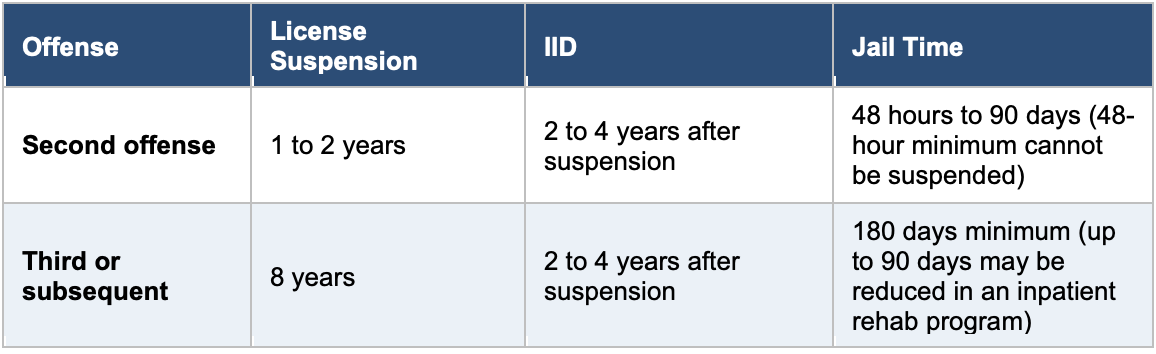
These are serious, life-altering consequences. With these offenses, there is mandatory jail time and extensive suspensions. An 8-year license suspension for a third offense means nearly a decade without the legal ability to drive. Fines range from $500–$1,000.
There is one provision in the statute that can work in a repeat offender’s favor. Under N.J.S.A. 39:4-50, if your second DWI occurs more than 10 years after your first, the court must treat the second conviction as a first offense for sentencing purposes. Similarly, if a third offense occurs more than 10 years after the second, it is sentenced as a second offense.
This can make an enormous practical difference. The gap between a third-offense sentence (180 days in jail and an 8-year suspension) and a second-offense sentence (as few as 48 hours in jail and a 1-to-2-year suspension) is significant. If it has been more than 10 years since your last DWI, an experienced attorney can make sure the court applies the step-down correctly.
It’s worth noting, however, that a DWI stays on your New Jersey driving record permanently. There is no mechanism to expunge it because DWI is classified as a traffic offense, not a criminal offense, and traffic offenses are not eligible for expungement.
Many people are surprised to learn that refusing a breathalyzer in New Jersey is a separate offense with its own mandatory penalties — and those penalties apply even if the DWI charge is dismissed.
Under New Jersey’s implied consent law (N.J.S.A. 39:4-50.2), every driver on New Jersey roads has already consented to submit to a breath test if an officer has probable cause to believe they are driving while intoxicated. Refusing to blow triggers a charge under N.J.S.A. 39:4-50.4a, which carries the following penalties:
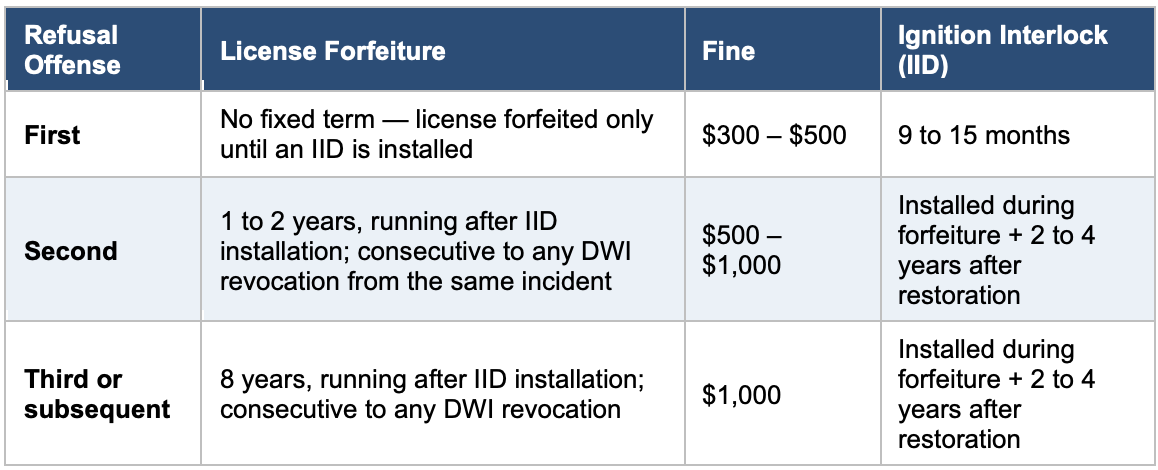
A few critical details about refusal charges:
For a first refusal, the judge has discretion to run the refusal suspension concurrently with (at the same time as) any DWI suspension from the same incident. However, for a second or subsequent refusal, the suspension runs consecutively — meaning back-to-back with any DWI suspension. This can result in years without a license.
Refusal also does not prevent the state from pursuing a DWI charge against you. Prosecutors can still build a case using officer observations, field sobriety test results, dashcam footage, and other evidence. In many cases, refusing the test doesn’t help your defense and only adds a separate charge with its own mandatory penalties.
New Jersey does not offer hardship licenses, work licenses, or restricted driving permits of any kind during a DWI or refusal suspension. Unlike many other states, there is no temporary license that allows you to drive to work or medical appointments. During a fixed suspension period, you cannot legally drive for any reason.
One of the most recent changes to New Jersey DWI law is the “2-for-1” IID credit provision, most recently updated by P.L. 2025, c.41 (effective April 3, 2025). This provision allows eligible offenders to reduce their license suspension period by voluntarily installing an ignition interlock device.
Here’s how it works: for every two days you have the IID installed and maintain a driver’s license with the appropriate IID notation, you receive a one-day credit against your suspension period. In other words, you can potentially cut your suspension time significantly — or even eliminate it entirely — by installing the device early.
However, this credit is not available in two situations:
If you may be eligible for this credit, it’s important to act quickly. The IID must be installed voluntarily, and you must request the appropriate license notation from the Motor Vehicle Commission (MVC) — typically within seven days of receiving the required documentation.
If your license is suspended because of a DWI and you get caught driving, you could face a brand-new charge that’s even more serious than the DWI itself. Under N.J.S.A. 2C:40-26, this can be a fourth-degree crime — and unlike a DWI, that’s an actual criminal charge.
This tougher charge doesn’t apply to everyone, though. It kicks in in two situations: if your license was suspended for a second (or later) DWI, or if you were suspended for a first DWI and had already been caught driving on that suspension once before. When it does apply, the penalty is steep: at least 180 days in jail, with no chance of early release during that time.
The bottom line is simple — if your license is suspended for a DWI, don’t drive. The risk isn’t worth it.
Can I still drive to work after a first-offense DWI in New Jersey?
In most first-offense cases, yes. Under the 2019 reform, most first-time offenders are not subject to a timed license suspension. Instead, your license is forfeited only until you install an IID, at which point you can drive — as long as the vehicle is equipped with the device. The exception is a first offense with a BAC of 0.15% or higher, which carries a 3-month suspension, and drug DUIs, which carry a 7-to-12-month suspension.
Does a DWI go on my criminal record in New Jersey?
No. A DWI is a traffic offense in New Jersey and does not result in a criminal record. However, it does remain on your driving record permanently and cannot be expunged.
How long does a DWI stay on my record in New Jersey?
Permanently. There is no time limit and no way to remove a DWI from your New Jersey driving record. New Jersey also has no lookback period limitation — a DWI from decades ago still counts as a prior offense if you are charged again (although the 10-year step-down rule may reduce how the sentencing is applied).
What is an ignition interlock device (IID)?
An IID is a small breathalyzer-type device installed in your vehicle. Before the engine will start, you must blow into the device and register a BAC below a set threshold. The device also requires periodic retests while driving. IIDs are installed and monitored by MVC-approved vendors, and you are responsible for the cost.
Is refusing a breathalyzer test better than failing it?
Generally, no. Refusing a breath test in New Jersey triggers a separate charge with mandatory penalties — including a license suspension of 7 to 12 months on a first offense — and does not prevent the state from pursuing DWI charges using other evidence. In many cases, a refusal actually makes the situation worse by adding penalties on top of the DWI consequences.
Can I get a hardship or work license during my DWI suspension?
No — New Jersey doesn’t offer hardship licenses, conditional licenses, or work-only permits the way some states do. The one form of restricted driving available is the IID-restricted license when there is no fixed suspension term. There’s no separate “drive only to work” privilege beyond that.
If you’ve been charged with a DWI or DUI in New Jersey, the outcome of your case can depend on the specific facts — your BAC level, whether you refused a breath test, whether procedures were followed correctly, and whether this is your first offense.
As an attorney with experience in DWI representation in Gloucester, Burlington, Camden, and Atlantic County, I can evaluate your case, identify potential defenses, and help you understand your options for protecting your license and your future.
This article is provided for general informational purposes only and does not constitute legal advice or create an attorney-client relationship. Every case is different; consult a licensed New Jersey attorney about your specific situation.